Digital OKR Execution: Where Strategy Meets Software
OKR Execution
Every year, businesses invest millions in strategy—yet studies show that over 90% of strategic plans fail due to poor execution.
Imagine a scenario where teams know exactly how their daily work contributes to company objectives, and leaders can predict roadblocks before they occur.
This is the promise of digital OKR execution, where software and strategy converge to deliver measurable results.
A recent survey by Gallup found that only 21% of employees are actively engaged at work, and that engagement drops significantly when objectives are unclear.
Clearly, aligning strategy with execution is not optional—it’s critical. Modern OKR Software is turning this alignment into a science, not a guessing game.
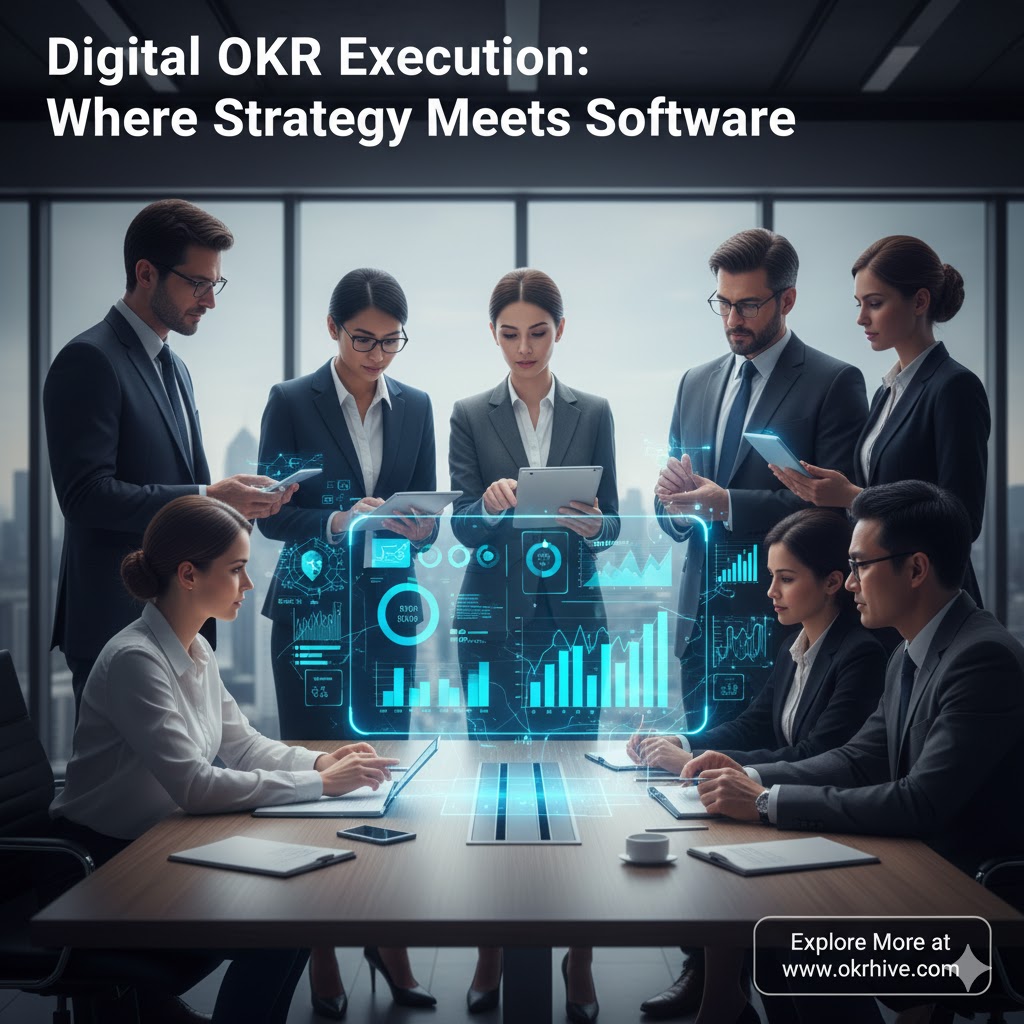
What is Digital OKR Execution?
OKR Execution is the process of transforming organizational objectives into measurable key results and ensuring they are actively achieved.
When executed digitally, OKRs are tracked using real-time dashboards, AI-powered insights, and automated reporting, replacing static spreadsheets and siloed processes.
By integrating OKR system implementation with everyday workflows, organizations can:
Monitor progress in real-time
Forecast performance and risks
Align teams across functions
Increase accountability at every level
According to Gartner, organizations that adopt digital OKRs experience 40% higher strategic alignment and goal completion rates than those using traditional methods.
The Hidden Power of Digital OKR Execution
While many see OKRs as a goal-setting tool, advanced OKR deployment unlocks behavioral insights and predictive capabilities:
Behavioral OKRs: Modern platforms track patterns like procrastination, collaboration frequency, and response times, helping leaders identify and address hidden obstacles.
Predictive Analytics: Using historical OKR data, AI can forecast the likelihood of achieving objectives, enabling proactive adjustments.
A study by McKinsey found predictive OKRs increased goal achievement by 30%.
- Adaptive OKRs: Instead of static quarterly targets, objectives can be adjusted dynamically based on team bandwidth, market conditions, or customer feedback.
These features transform OKRs from a static measurement tool into a living, adaptive system that drives real results.
Practical Examples of Digital OKR Execution
Example 1: Retail Chain Using Customer-Centric OKRs
A national retail chain struggled with low customer satisfaction scores despite clear operational goals. By implementing digital OKR execution via OKR Hive, the company created customer-centric objectives:
Objective: Improve in-store customer experience
Key Results:
Reduce average checkout time from 8 to 5 minutes
Increase customer satisfaction survey scores from 78% to 90%
Train 100% of store staff on personalized service techniques
With real-time dashboards, managers could see which stores were underperforming and take corrective actions immediately.
Within six months, the chain saw a 15% increase in customer satisfaction and a 10% increase in repeat visits.
Example 2: SaaS Startup Tracking Innovation
A SaaS startup wanted to boost innovation while keeping product releases on schedule. By applying OKR system implementation, they introduced innovation OKRs:
Objective: Increase product innovation velocity
Key Results:
Launch 3 new feature experiments per quarter
Achieve 80% internal adoption of new tools
Reduce feature development cycle time from 6 weeks to 4 weeks
With digital OKR software, leadership could visualize progress across teams, identify bottlenecks, and reward creative contributions.
As a result, the startup cut development cycle times by 33% and improved customer satisfaction scores by 20%.
Example 3: Manufacturing Company Aligning Global Teams
A multinational manufacturing firm faced challenges in aligning objectives across regions. Using OKR deployment via digital tools, they implemented cross-regional OKRs:
Objective: Standardize production efficiency across global plants
Key Results:
Reduce downtime by 15% in all plants
Implement standardized reporting in 100% of plants
Achieve at least 90% compliance with safety protocols
Real-time dashboards allowed headquarters to identify lagging regions, share best practices, and implement targeted interventions. Within a year, the firm achieved a 20% improvement in production efficiency.
Key Features for Effective Digital OKR Execution
For organizations looking to maximize results, OKR Software should include:
Unified Dashboards: Monitor objectives and key results in a single view
Real-Time KPI Integration: Automatic updates reduce manual tracking errors
AI-Driven Insights: Predict potential risks and highlight improvement opportunities
360-Degree Feedback: Incorporate input from peers, managers, and self-assessments
Cross-Platform Access: Mobile and cloud-enabled for hybrid teams
Collaborative Features: Comments, notifications, and progress sharing
Portfolio & Thematic Tracking: Align multiple objectives under strategic themes
OKR Hive provides all these features, empowering companies to transform strategy into action seamlessly.
Steps to Implement Digital OKRs with Impact
Define Strategic Objectives: Translate company priorities into actionable goals.
Set Measurable Key Results: Each objective should have clear, quantifiable outcomes.
Select the Right Software: Platforms like OKR Hive ensure visibility, alignment, and analytics.
Communicate Objectives Across Teams: Ensure understanding and buy-in at all levels.
Monitor Progress Continuously: Use dashboards, alerts, and predictive analytics to stay on track.
Integrate with Performance Management: Tie OKRs to reviews, feedback, and incentives.
Review and Iterate: At the end of each cycle, analyze results, learn from gaps, and improve the next OKR cycle.
Organizations following these steps have reported 20–25% higher employee engagement and 30% faster achievement of strategic goals.
Overcoming Execution Challenges
Even with digital platforms, organizations must address common obstacles:
Resistance to Change: Employees may be wary of new tools or processes. Provide training and showcase value.
Data Overload: Too many metrics can overwhelm teams; focus on meaningful OKRs.
Static Goals: Avoid quarterly-only updates. Adapt objectives based on progress, market, and employee capacity.
A robust platform like OKR Hive mitigates these challenges through automation, AI insights, and intuitive dashboards, enabling effective execution at scale.
The Future of Digital OKR Execution
The next frontier of OKR Execution includes:
Self-Learning OKRs: AI suggests new objectives or modifies key results based on historical data.
Global OKR Networks: Visualize goal alignment across distributed teams.
Behavioral Indexing: Track team behaviors and engagement to improve execution.
Culture & Innovation Metrics: Measure not just outputs, but the health of organizational culture and creativity.
Forward-thinking organizations are already leveraging these innovations to stay ahead of competition, turning strategy into predictive, adaptive, and measurable action.
Why Choose OKR Hive
For organizations seeking next-level OKR execution, OKR Hive stands out due to:
Unified Dashboards: Centralized view of all OKRs and progress
AI-Powered Insights: Predict challenges and suggest improvements
Integration with Performance Management: Seamlessly connects with reviews and feedback systems
Collaboration Tools: Enables team discussions, comments, and updates
Scalability: Suitable for startups, SMEs, and enterprises
With OKR Hive, companies don’t just track objectives—they execute strategy efficiently, adapt dynamically, and achieve measurable impact.
Conclusion
In today’s fast-paced business world, strategy alone is insufficient. Digital OKR Execution ensures objectives are measurable, aligned, and actionable. By leveraging OKR Software like OKR Hive, companies can:
Track progress in real-time
Align teams across departments and geographies
Predict risks and adapt objectives dynamically
Drive accountability, engagement, and innovation
Organizations that embrace modern, data-driven OKR execution are not only achieving goals—they are building a culture of performance, agility, and continuous improvement.